Certified Transaction Coordination Specialist
An online transaction coordinator course and certification for real estate agents and their assistants.
Carry every deal from signed contract to closing without a missed deadline.

About the CTCS
What the Certified Transaction Coordination Specialist covers
The Certified Transaction Coordination Specialist designation covers the work that starts when a purchase contract is signed and ends when the deal closes. You will learn to read an executed contract the way a coordinator does, pulling out every contingency, deadline, and obligation, without stepping into legal drafting. You will build a timeline, coordinate the lender, title or escrow, inspector, and appraiser, keep clients and the other agent informed, and assemble a complete file that meets your brokerage's compliance requirements. It is designed for agents who manage their own pending deals and for transaction coordinators and assistants who manage files for an agent or a team.
Why it matters
Why agents earn the CTCS
Clients judge an agent heavily on the weeks between contract and closing, when silence feels like trouble, so an agent or coordinator who keeps every party informed and every deadline visible protects the deal, the client relationship, and the referrals that follow.
Who it is for
Is this designation right for you?
- Agents who manage their own files from contract to close
- Transaction coordinators who want a structured, verifiable credential
- Assistants taking on pending-file duties for a team
- Agents preparing to hire or train a transaction coordinator
The curriculum
What you will learn
4 units, each with a practice quiz and a hands-on assignment, then the final exam. The topics they cover:
Reading the contract for action
Identifying contingencies, deadlines, and obligations in an executed purchase contract at agent level, without drafting or interpreting legal terms.
Building the transaction timeline
Converting contract dates into a calendar, confirming how days are counted locally, and setting reminders ahead of each deadline.
Coordinating lender, title, inspection, and appraisal
Knowing what each party needs, when they need it, and how to follow up before a delay becomes a missed date.
Client and agent communication
A steady update rhythm that keeps buyers, sellers, and the other agent informed without flooding anyone's inbox.
File compliance and documentation
Assembling a complete transaction file with signed disclosures, addenda, and receipts that meets your brokerage's review standards.
Roles, licensing limits, and handoffs
What a licensed agent must handle personally, what an assistant may do under state rules, and how to hand off cleanly.
The payoff
What you will be able to do
- Extract every deadline and contingency from an executed purchase contract
- Maintain a timeline that flags each date before it arrives
- Coordinate lender, title, inspector, and appraiser updates on a set schedule
- Assemble a transaction file that passes brokerage compliance review
- Communicate progress to clients in plain, regular, predictable updates
In practice
What the CTCS looks like in your business
Picking up a file already in progress
An agent on your team hands you a pending deal halfway through escrow because they are leaving on vacation. You start by reading the executed contract and every addendum in order, building a list of each deadline, what has been satisfied, and what is still open. You compare that list to the file itself and find that the earnest money receipt is missing and the appraisal has not been scheduled. You email the escrow officer for the receipt, call the loan officer to confirm the appraisal order, and note both items with a follow-up date. Then you introduce yourself to the clients and the other agent, explaining whom to contact for what while the agent is away. Anything that involves negotiating terms or advising the clients goes back to a licensed agent, and your notes make that handoff easy.
An inspection deadline with no report yet
Your buyer's inspection response period ends in two days, and the inspector's written report has not arrived. You call the inspection company, learn the report is waiting on a sewer scope result, and ask for a firm delivery time. Then you alert the buyer's agent, because deciding whether to request an extension, and negotiating it, is their call. If you are the agent, you make that decision with your buyer now rather than on the final afternoon. Either way, you check how your contract counts days and whether the deadline lands on a weekend, and you prepare the extension form your brokerage uses in case it is needed. When the report arrives, you send it to the agent and buyer at once with the deadline restated at the top. The course trains you to spot these collisions days ahead.
A file that fails broker review
Your brokerage's compliance reviewer sends a file back a week before closing: a seller disclosure is missing a signature, one counteroffer page lacks the buyer's initials, and the lead-based paint disclosure is absent even though the house was built before 1978. None of these may hold up the loan, but each matters to your brokerage and could matter later if anything goes wrong. You list the gaps, check which party needs to sign what, and send each signer a short, specific request through your e-signature platform rather than a vague note that something is missing. You track replies daily and resubmit only when the file is complete. The course shows you how to run a checklist at acceptance and again before closing, so the reviewer finds a finished file instead of a to-do list.
Who earns it
Who earns the CTCS and why it pays off
Two groups earn CTCS. The first is agents who run their own pending files and want a dependable system in place of sticky notes and scattered email threads. The second is transaction coordinators and assistants, whether employed by a team, contracted by several agents, or building their own coordination business, who want a credential showing they know the contract-to-close process and its limits. For coordinators, a public verification page is a simple way to show a new agent client that you have been trained and tested. For agents, the designation changes the conversation at contract signing: you can describe exactly what will happen, who will contact the client, and when, which turns an anxious stretch into a predictable one. Loan officers, escrow and title staff, and closing attorneys tend to favor the agents and coordinators whose files arrive complete. CTCS pairs well with the Advanced Real Estate Negotiator designation, since negotiations often reopen during inspection and appraisal, and with the Certified AI Real Estate Expert designation for e-signing and wire-fraud safety habits.
Licensing, CE credit and NAR
The Certified Transaction Coordination Specialist is an independent designation from ACI. It is not a real estate license, it does not license you as an escrow, title, or closing agent, and it does not permit an unlicensed person to perform tasks that state law reserves for licensees. It is not state continuing-education credit, and ACI is not affiliated with or endorsed by the National Association of REALTORS (NAR). No NAR designation covers this exact niche of contract-to-close coordination. CTCS concentrates on the coordination work itself, is studied online at your own pace, can be checked by anyone on a public verification page, and is renewed yearly with a short update on changes in practice. Transaction rules vary by state, so check yours.
What is included
Every ACI designation includes
- Scenario-based lessons built around real transactions and client conversations
- Copy-and-use scripts, checklists, and templates you can apply this week
- A final exam with written answers read by a real marker, not just a click-through quiz
- A printable certificate plus a verifiable digital badge
- Post-nominal letters you can add to your name and marketing
The process
How it works
Enroll online
Get instant access to the CTCS coursework. No scheduling, no classroom.
Learn at your pace
4 practical, scenario-based units with practice quizzes and hands-on assignments.
Pass the exam
Multiple choice plus short written answers, read by a person. 2 attempts included.
Earn your designation
Receive your CTCS certificate, a shareable badge, and a public verification page.
30-day money-back guarantee
Enroll with confidence. If a designation is not right for you, email us within 30 days for a full refund. No forms, no hassle.
Two exam attempts are included with every designation, and if you need another we add it at no extra cost.
Your CTCS certificate
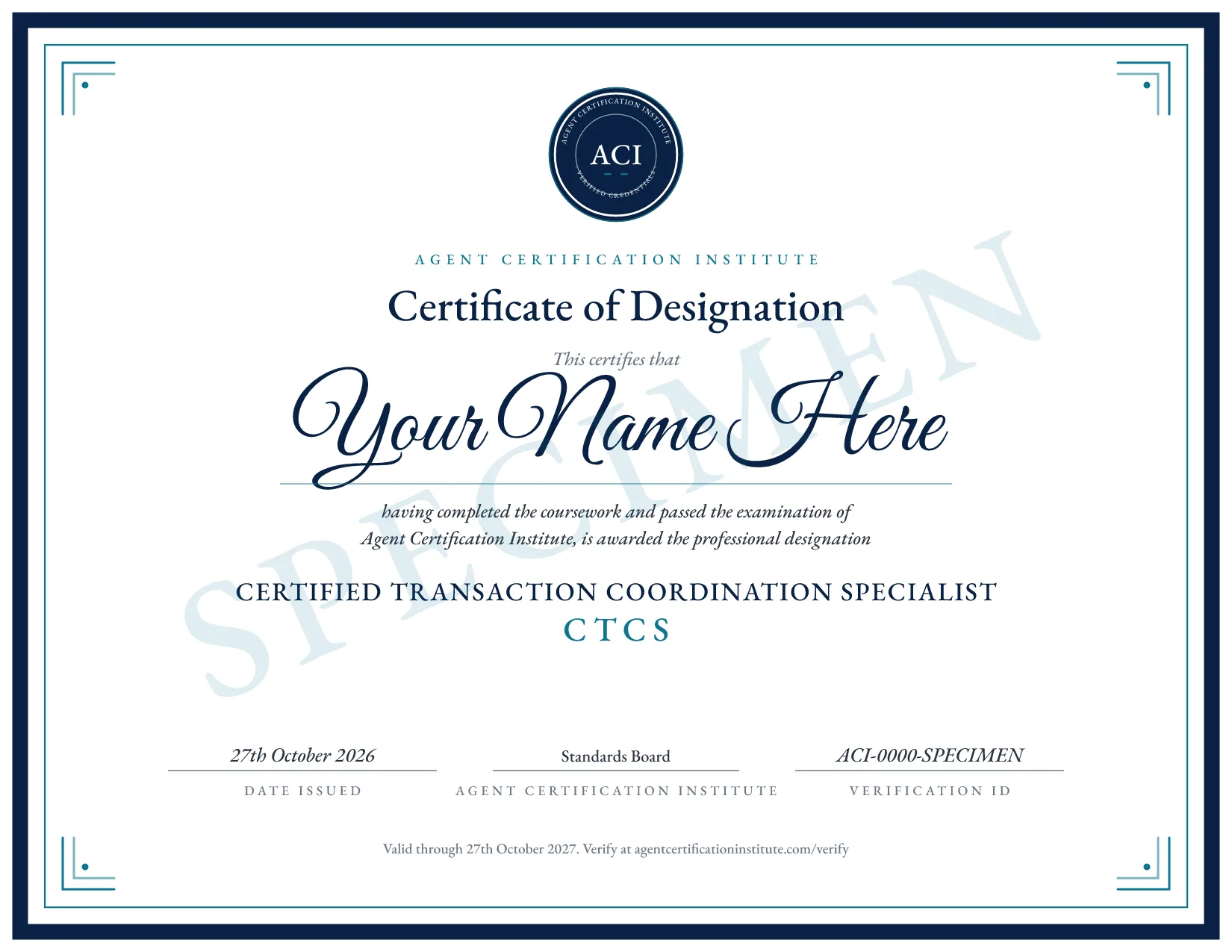
- 1A full US Letter certificate in your name, as a print-ready PDF and an image for your website and listings.
- 2Dated the day you pass and valid for 12 months, with a verification ID anyone can check on our public register.
- 3Renewed each year with a short update on what changed and a ten-question check ($29, or free with All-Access). You get a re-dated certificate and badge.
Questions
Frequently asked
Is the Certified Transaction Coordination Specialist designation affiliated with NAR?+
No. The Certified Transaction Coordination Specialist is an independent designation from Agent Certification Institute. It is not affiliated with or endorsed by the National Association of REALTORS. It certifies that you completed our contract-to-close coordination training and passed the final exam, and anyone can confirm your status on your public verification page.
Do I need a real estate license to take CTCS?+
The course is written for licensed agents, and transaction coordinators and assistants are welcome to take it too. Earning the designation does not change what you are allowed to do. Whether an unlicensed coordinator may handle a given task, such as discussing terms with the other side, depends on your state and brokerage, so confirm those rules first.
Does CTCS teach contract drafting?+
No. CTCS works with contracts that are already written and signed. You learn to read them at agent level, track what they require, and notice when something needs attention from the agent, the broker, or a real estate attorney. Writing or interpreting contract language is legal work, and the course is clear about where that line sits.
Can CTCS support starting an independent transaction coordination business?+
It can serve as evidence that you have been trained and tested on the contract-to-close process. It does not cover business setup, service agreements with agents, or insurance, and it grants no license. Some states limit what an unlicensed coordinator may do or require a license for certain tasks, so research your state's rules and talk with the brokerages you plan to work with before taking on clients.
Does CTCS work in attorney states as well as escrow states?+
Yes. The course teaches the coordination process in a way that applies whether closings in your area run through an attorney, a title company, or an escrow office. It explains who usually handles what in each model, so you know whom to call for documents and scheduling. Local practice still varies a great deal, so the written assignments ask you to map the process as it actually works in your own market.
Is CTCS a good fit for a newer agent?+
Yes, and it sits on the New Agent Path for that reason. The first few pending deals are where newer agents most often feel lost, and learning to read a contract for deadlines, build a timeline, and keep every party informed gives you a routine before bad habits form. Your broker remains your first resource on local forms and office policy, and the course helps you arrive with clearer questions.
How long does it take?+
It is self-paced and fully online: 4 units, each a solid evening of reading plus a practice quiz and a short assignment you do in your own business. Most agents finish over a week or two. Written exam answers are marked within two business days.
Is it verifiable?+
Yes. Every CTCS holder gets a public verification page and a shareable digital badge for LinkedIn, your bio, and your email signature.
How long is it valid?+
Your CTCS certificate is dated the day you pass and is valid for 12 months, and your badge shows the years it is current for. A month before it lapses we email you. Renewing means reading that year's short update on what changed for CTCS holders and answering ten multiple-choice questions, for $29; you then get a re-dated certificate and badge. All-Access members renew free.
Is there a guarantee?+
Yes. Enroll with confidence. If a designation is not right for you, email us within 30 days for a full refund. No forms, no hassle. Two exam attempts are included with every designation, and if you need another we add it at no extra cost.
Can I get this and others for one price?+
Yes. The all-access membership unlocks CTCS and every other designation for $199 a year, and saves $1450 against buying the catalog one at a time.
Be first in when the CTCS opens
Every course is written to our full standard before it goes on sale. Leave your email and we will tell you the day enrollment opens. One email, no spam.
You are on the list. We will email you the day it opens.
Guides for agents
Part of a learning path
CTCS is one step in these paths: a suggested set of designations, in the order an agent tends to need them.