Advanced Real Estate Negotiator
An online real estate negotiation course and certification for agents on either side of the deal.
The negotiation playbook that protects your clients and your commission.

About the AREN
What the Advanced Real Estate Negotiator covers
The Advanced Real Estate Negotiator designation teaches a structured way to negotiate residential deals from the first offer to the final signature. You will work through a planning method you can apply to any file, the mechanics of offers and counteroffers, how to handle inspection-driven requests for repairs and credits, and how to hold your ground when your own compensation becomes part of the discussion. Each unit pairs a practice quiz with a written assignment built around realistic deal situations, so you rehearse decisions before a live client depends on them. It suits agents on either side of the table, from those a year or two into the business to veterans who want to replace habit with a deliberate approach.
Why it matters
Why agents earn the AREN
With compensation now openly negotiated in every buyer agreement and listing conversation, and with clients comparing agents more closely than before, an agent who can explain and run a clear negotiation process gives clients a concrete reason to hire them and to stay.
Who it is for
Is this designation right for you?
- Agents who want a planning routine before every offer
- Listing agents whose sellers react emotionally to low offers
- Buyer agents tired of losing ground at the inspection stage
- Agents who struggle to explain and defend their compensation
The curriculum
What you will learn
4 units, each with a practice quiz and a hands-on assignment, then the final exam. The topics they cover:
A planning method for every deal
Setting your client's priorities, walk-away point, and likely trade-offs in writing before any offer is written or answered.
Writing and answering offers
How the price, timing, and contingency terms of an offer work together, and how to frame a counter that moves things forward.
Concessions that buy something back
Pairing every give with a get so your client's flexibility earns value instead of simply shrinking their position.
Repairs, credits, and price adjustments
Turning an inspection report into a proposal both sides can sign, and choosing between repairs, credits, and price changes.
Keeping talks productive under pressure
Managing tone, timing, and written follow-up so a tense exchange stays professional and the deal stays alive.
Protecting your compensation
Discussing and defending your fee in listing and buyer agreements, knowing commissions are negotiable and never fixed by custom.
The payoff
What you will be able to do
- Write a one-page negotiation plan for any residential transaction
- Compare offers by net result, risk, and timing, not price alone
- Draft counteroffers that trade concessions rather than surrender them
- Choose between repairs, credits, and price changes after an inspection
- Explain your compensation clearly and negotiate it without apologizing
In practice
What the AREN looks like in your business
Planning the offer with your buyer
Your buyers have found the house they want and are ready to write tonight. Before you open the form, you spend a few minutes on a short plan. You ask what matters most: the price, the move-in date, keeping their inspection rights, or getting help with closing costs. You agree on the highest price they will pay and write it down, so the number is settled before the excitement of a counter arrives. You also look at what the seller seems to need, based on days on market, any price changes, and what the listing agent shared when you called ahead. That plan shapes the opening offer and tells you in advance which terms you can give up later without hurting your buyers. When the counter comes, you are comparing it to a decision already made rather than inventing one under pressure.
Presenting a low offer to your seller
An offer arrives well below asking, and you already know your seller will take it personally. Instead of forwarding the file, you call and set the frame first: a low opening is information, not an insult, and the buyer has made the first move. You review the terms beyond price, such as how the buyer is financing, how long they want for inspection, and their proposed closing date, because some of those may be worth more to your seller than a modest difference in price. Together you decide whether to counter at list, counter somewhere in between, or hold price firm and counter on terms. You explain that a counter keeps the buyer engaged, while a silent rejection usually ends the conversation. Your seller signs a counter with a clear reason behind it, and you send it with a short, courteous note.
Negotiating your pay inside a buyer's offer
Your buyer agreement spells out how you will be paid and what happens if a seller does not cover it. Your buyer now wants to ask the seller to contribute toward your compensation as part of the offer. You explain the options plainly: the request can be written as a term of the offer where your local forms and brokerage allow it, the seller can accept, refuse, or counter it like any other term, and none of it changes what the agreement says your buyer owes. You help your buyer weigh that request against price and repairs, because every concession asked of the seller competes with the others. When the seller counters with partial help, you have already discussed whether your buyer will cover the rest or adjust elsewhere. The conversation stays focused on your buyer's total cost, which keeps your fee from becoming the sticking point.
Who earns it
Who earns the AREN and why it pays off
The Advanced Real Estate Negotiator designation is built for agents who want negotiation to be a skill they can describe, not a personality trait. Listing agents use it to explain at the listing appointment how offers will be reviewed and countered, which gives sellers a concrete picture of the service they are hiring. Buyer agents use it in the consultation, where a clear account of how you prepare offers and handle inspection requests helps a buyer understand what the written agreement is paying for. Newer agents gain a structure that keeps them from conceding early simply to avoid conflict, and brokers who mentor newer agents get a common language for reviewing a file afterward. Agents across the table notice too: a counterpart who is prepared, prompt, and fair is someone they hope to see on the next deal, and that reputation travels through a local market. AREN leads directly to the Master Real Estate Negotiator designation, and many agents pair it with the Certified Market Analysis Specialist designation, because a well-supported price gives every negotiation firmer footing.
Licensing, CE credit and NAR
The Advanced Real Estate Negotiator is an independent designation from ACI. It is not a real estate license, it does not authorize any activity that requires a license, and it does not count as state continuing-education credit. ACI is not affiliated with or endorsed by the National Association of REALTORS (NAR). The NAR credential closest to this ground is the Real Estate Negotiation Expert (RENE) certification, a respected program that also concentrates on negotiation skills for agents. AREN takes a different format: you study online at your own pace, finish with an exam that includes written answers read by a person, hold a certificate anyone can confirm on a public verification page, and renew each year with a short update. Plenty of agents find room for both on their resume.
What is included
Every ACI designation includes
- Scenario-based lessons built around real transactions and client conversations
- Copy-and-use scripts, checklists, and templates you can apply this week
- A final exam with written answers read by a real marker, not just a click-through quiz
- A printable certificate plus a verifiable digital badge
- Post-nominal letters you can add to your name and marketing
The process
How it works
Enroll online
Get instant access to the AREN coursework. No scheduling, no classroom.
Learn at your pace
4 practical, scenario-based units with practice quizzes and hands-on assignments.
Pass the exam
Multiple choice plus short written answers, read by a person. 2 attempts included.
Earn your designation
Receive your AREN certificate, a shareable badge, and a public verification page.
30-day money-back guarantee
Enroll with confidence. If a designation is not right for you, email us within 30 days for a full refund. No forms, no hassle.
Two exam attempts are included with every designation, and if you need another we add it at no extra cost.
Your AREN certificate
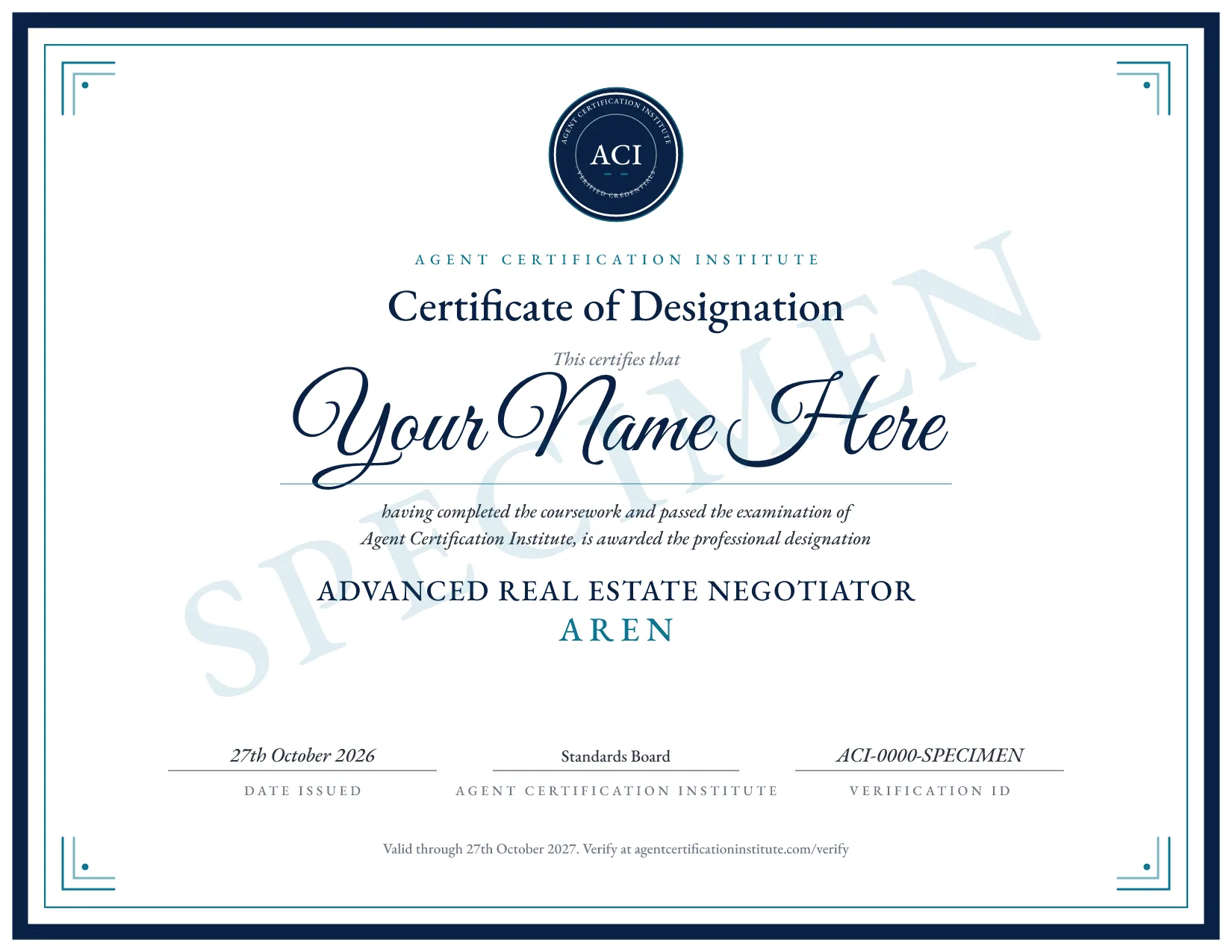
- 1A full US Letter certificate in your name, as a print-ready PDF and an image for your website and listings.
- 2Dated the day you pass and valid for 12 months, with a verification ID anyone can check on our public register.
- 3Renewed each year with a short update on what changed and a ten-question check ($29, or free with All-Access). You get a re-dated certificate and badge.
Questions
Frequently asked
Is the Advanced Real Estate Negotiator designation affiliated with NAR?+
No. The Advanced Real Estate Negotiator is an independent designation from Agent Certification Institute. It is not affiliated with or endorsed by the National Association of REALTORS, and holding it implies no connection to NAR membership. It shows that you completed our negotiation training and passed the final exam, which anyone can confirm on your public verification page.
Are there prerequisites for AREN?+
None beyond a real estate practice and a wish to negotiate more deliberately. You do not need a set number of closed deals. Newer agents get a structure to build on from the start, and experienced agents use the written assignments to test their habits against a clear method. AREN is also the foundation for the Master Real Estate Negotiator designation.
What does AREN cover, and what does it leave out?+
It covers everyday residential negotiation: planning, offers and counteroffers, repair and credit requests, and conversations about your own compensation. It does not teach contract drafting or give legal advice, so your state forms, your broker, and a real estate attorney remain your sources there. Multiple-offer rounds, appraisal gaps, and escalation clauses are covered in depth in the Master Real Estate Negotiator designation.
Does AREN help when the other party has no agent?+
It covers the preparation and communication habits that matter most in that situation, such as setting out terms in writing and keeping a clear record of each exchange. Working opposite an unrepresented buyer or seller also raises questions about what you may say and whose interests you serve, and those rules vary by state and brokerage. The course flags where to check your own rules and when to bring in your broker.
How long does AREN take to complete?+
There is no fixed timetable, and a few weeks of evenings is a common pace. The four units each close with a practice quiz and a written assignment, and agents with an active deal often make that file the subject of their assignments, which keeps the material practical. You decide when to sit the final exam, so a busy month of closings simply means you pause and pick up where you left off.
Can I take AREN and the Master Real Estate Negotiator at the same time?+
You can enroll in both, but working through them in order makes more sense. The master-level course assumes you already plan a negotiation, structure counters, and handle repair requests the way AREN teaches, and it spends its time on harder scenarios instead. Agents who finish AREN first usually find the advanced material easier to apply, because the basic method has already become a habit.
How long does it take?+
It is self-paced and fully online: 4 units, each a solid evening of reading plus a practice quiz and a short assignment you do in your own business. Most agents finish over a week or two. Written exam answers are marked within two business days.
Is it verifiable?+
Yes. Every AREN holder gets a public verification page and a shareable digital badge for LinkedIn, your bio, and your email signature.
How long is it valid?+
Your AREN certificate is dated the day you pass and is valid for 12 months, and your badge shows the years it is current for. A month before it lapses we email you. Renewing means reading that year's short update on what changed for AREN holders and answering ten multiple-choice questions, for $29; you then get a re-dated certificate and badge. All-Access members renew free.
Is there a guarantee?+
Yes. Enroll with confidence. If a designation is not right for you, email us within 30 days for a full refund. No forms, no hassle. Two exam attempts are included with every designation, and if you need another we add it at no extra cost.
Can I get this and others for one price?+
Yes. The all-access membership unlocks AREN and every other designation for $199 a year, and saves $1450 against buying the catalog one at a time.
Be first in when the AREN opens
Every course is written to our full standard before it goes on sale. Leave your email and we will tell you the day enrollment opens. One email, no spam.
You are on the list. We will email you the day it opens.
Guides for agents
Part of a learning path
AREN is one step in these paths: a suggested set of designations, in the order an agent tends to need them.