Master Real Estate Negotiator
An advanced real estate negotiation course and certification for agents who handle competitive deals.
Multiple offers, appraisal gaps and hardball counters, handled.

About the MREN
What the Master Real Estate Negotiator covers
The Master Real Estate Negotiator designation picks up where the Advanced Real Estate Negotiator leaves off and focuses on the deals that test even experienced agents. You will work through multiple-offer situations from both the listing and the buyer side, the options available when an appraisal comes in below the contract price, the mechanics and risks of escalation clauses, and ways to deal with counterparts who use pressure, deadlines, or bluffing as tactics. The written assignments place you inside realistic high-stakes scenarios and ask you to explain each decision. It is meant for agents who already negotiate everyday deals with confidence and now want a steadier hand when the stakes rise.
Why it matters
Why agents earn the MREN
When inventory is tight, the deals that matter most to clients often involve competing offers, stretched appraisals, or hard-edged counterparts, and the agent who handles those moments fairly and calmly is the one sellers hire and buyers recommend to friends.
Who it is for
Is this designation right for you?
- Agents who have finished AREN and want harder scenarios
- Listing agents who regularly receive several offers on one property
- Buyer agents competing for homes where inventory is scarce
- Team leaders who step in on the toughest negotiations
The curriculum
What you will learn
4 units, each with a practice quiz and a hands-on assignment, then the final exam. The topics they cover:
Running a multiple-offer process
Setting rules with your seller, communicating evenly with every buyer agent, and comparing offers on more than price.
Competing for buyers in bidding situations
Building an offer that stands out through terms, timing, and certainty without pushing your buyer past their limit.
Escalation clauses in practice
How escalation terms, caps, and proof requirements work, where they go wrong, and when local rules restrict them.
Appraisal gaps and low valuations
Weighing gap coverage, price reductions, splits, and reconsideration requests when appraised value and contract price diverge.
Hardball counterparts and pressure tactics
Recognizing bluffs, artificial deadlines, and anchoring, and responding firmly without escalating or giving ground for nothing.
Fairness, ethics, and documentation
Keeping a written record that shows every party was treated fairly and every client decision was fully informed.
The payoff
What you will be able to do
- Run a multiple-offer round that every party can see was fair
- Build buyer offers that compete on terms as well as price
- Explain escalation clause risks so buyers decide with full information
- Lay out realistic options when an appraisal falls short of price
- Respond to pressure tactics calmly while protecting your client's position
In practice
What the MREN looks like in your business
An escalation clause your buyer understands
Your buyers are about to compete for a house that has drawn heavy interest, and they ask about adding an escalation clause. Before anything goes into the offer, you walk them through how it works: their offer rises by a set increment above a competing bid, up to a cap they choose. You explain the trade-offs. A cap tells the seller the most your buyers will pay, and a vague proof requirement can leave them unsure whether the competing offer was real. You also note that some sellers prefer clean final numbers, and that whether escalation language is allowed, and on which form, depends on your state and brokerage. Your buyers decide to use it, with a cap they can live with if the house still goes elsewhere, and they understand that the cap may become the price. Their decision goes in writing.
Choosing between two strong offers
Two offers sit in front of your seller. One has the highest price, a small down payment, and a standard appraisal contingency. The other is lower but includes a written commitment to cover part of any appraisal shortfall and a larger down payment. Your seller's instinct is to take the bigger number. You build a simple comparison showing what happens to each offer if the appraisal comes in under the contract price, using recent sales to judge how likely that is. Seen side by side, the higher offer may shrink during escrow, while the lower one is more likely to reach closing on its stated terms. You do not choose for your seller. You lay out the risks, suggest countering the higher bidder with a request for some gap coverage, and let your seller decide with the full picture in front of them.
The other offer that may not exist
You submit a solid offer for your buyer, and the listing agent calls back within the hour: another offer is coming in higher, so your buyer should improve now. Maybe it is true and maybe it is not, and you cannot know. You avoid reacting to the claim itself. Instead, you ask neutral questions about timing, whether the seller is setting a deadline for best terms, and what matters to the seller besides price. Then you call your buyer and separate the facts from the pressure: their offer stands, they set a ceiling before writing it, and improving it is a choice rather than an obligation. If your buyer decides to raise the offer, you do it once, deliberately, and in writing. If not, you leave the offer in place and let the seller respond, which often reveals more than the phone call did.
Who earns it
Who earns the MREN and why it pays off
Agents earn MREN when their deals start arriving with complications attached. Listing agents in competitive areas use it to run offer rounds they can describe in detail to a prospective seller, which is a strong answer when a seller asks why they should hire you over another agent. Buyer agents use it to give clients an honest picture of their chances, a plan for appraisal risk, and a clear view of what an escalation clause commits them to. Team leaders who handle escalated negotiations, and brokers who field complaints when an offer round goes badly, gain a defensible process and a record that shows everyone was treated fairly. That fairness has a long tail: buyer agents who lost a round to you but felt it was run cleanly are more willing to bring their next buyer to your listings. MREN is the advanced step after the Advanced Real Estate Negotiator designation, and it pairs well with the Certified Market Analysis Specialist designation, because a well-supported price is your best footing when an appraisal question arises.
Licensing, CE credit and NAR
Master Real Estate Negotiator is an independent advanced designation from ACI. It is not a license of any kind, it gives no authority to perform work that requires a license, and it does not carry state continuing-education credit. ACI is not affiliated with or endorsed by the National Association of REALTORS (NAR). Agents weighing negotiation credentials will likely know NAR's Real Estate Negotiation Expert (RENE) certification, a well-regarded program covering negotiation for agents. MREN concentrates on specific high-pressure situations, including multiple offers, appraisal gaps, escalation clauses, and aggressive counterparts. It is studied online at your own pace, verified on a public page anyone can open, and renewed each year so your knowledge reflects how offer practices and local forms have changed.
What is included
Every ACI designation includes
- Scenario-based lessons built around real transactions and client conversations
- Copy-and-use scripts, checklists, and templates you can apply this week
- A final exam with written answers read by a real marker, not just a click-through quiz
- A printable certificate plus a verifiable digital badge
- Post-nominal letters you can add to your name and marketing
The process
How it works
Enroll online
Get instant access to the MREN coursework. No scheduling, no classroom.
Learn at your pace
4 practical, scenario-based units with practice quizzes and hands-on assignments.
Pass the exam
Multiple choice plus short written answers, read by a person. 2 attempts included.
Earn your designation
Receive your MREN certificate, a shareable badge, and a public verification page.
30-day money-back guarantee
Enroll with confidence. If a designation is not right for you, email us within 30 days for a full refund. No forms, no hassle.
Two exam attempts are included with every designation, and if you need another we add it at no extra cost.
Your MREN certificate
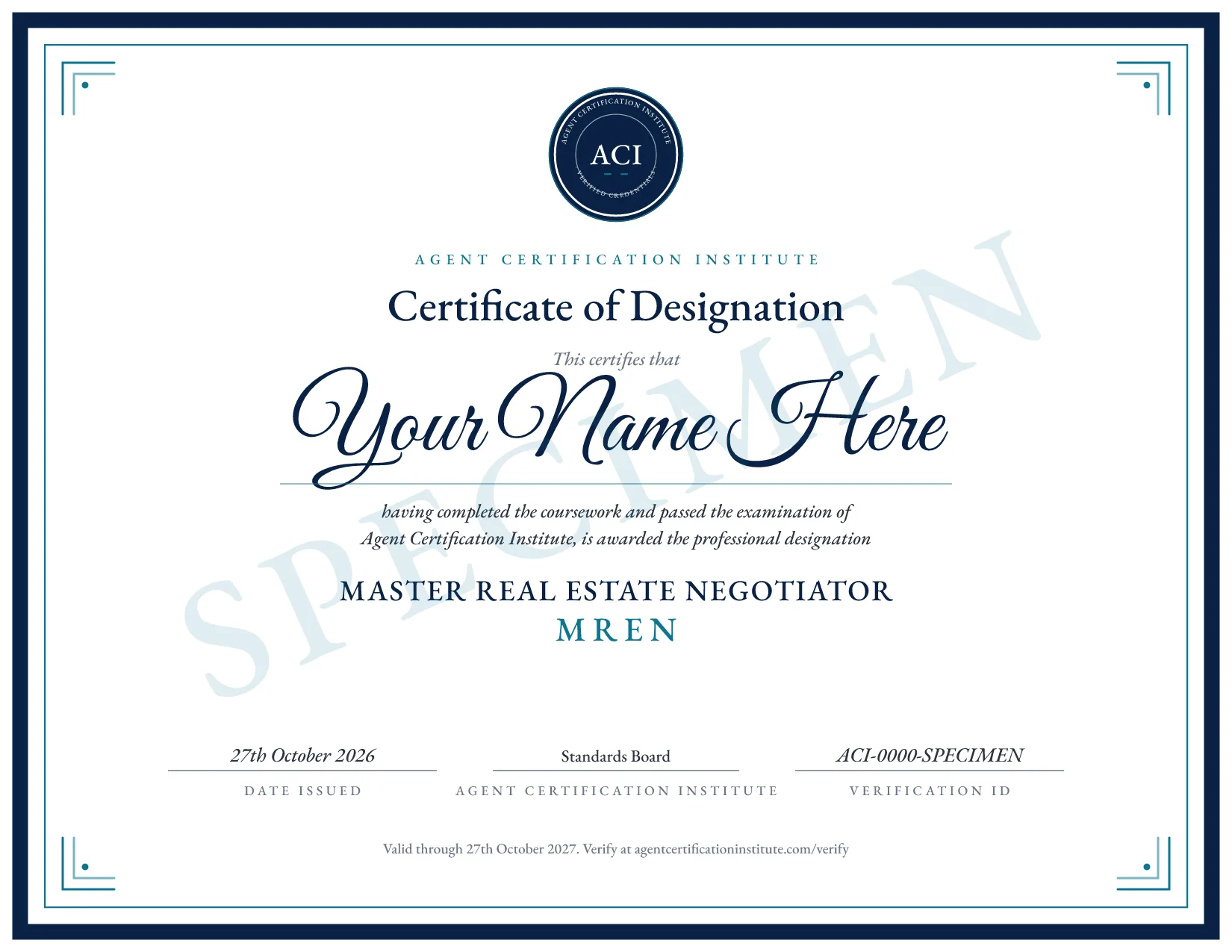
- 1A full US Letter certificate in your name, as a print-ready PDF and an image for your website and listings.
- 2Dated the day you pass and valid for 12 months, with a verification ID anyone can check on our public register.
- 3Renewed each year with a short update on what changed and a ten-question check ($29, or free with All-Access). You get a re-dated certificate and badge.
Questions
Frequently asked
Is the Master Real Estate Negotiator designation affiliated with NAR?+
No. The Master Real Estate Negotiator is an independent advanced designation from Agent Certification Institute. It is not affiliated with or endorsed by the National Association of REALTORS. It confirms that you completed our advanced negotiation training and passed its final exam, and your public verification page lets clients and colleagues check that it is current.
Do I need AREN before MREN?+
MREN builds on the Advanced Real Estate Negotiator designation, and the course assumes you already use its planning method and counteroffer approach. Agents who are new to structured negotiation should start with AREN. Experienced negotiators can begin with MREN, but they will move faster if the AREN vocabulary is familiar, since the advanced units refer back to it throughout.
Does MREN give legal guidance on multiple offers or escalation clauses?+
No. MREN teaches negotiation strategy and client communication around these situations. How offers may be disclosed, whether escalation clauses are permitted, and how they must be written are set by state law, local forms, and brokerage policy. The course points out where those rules apply and expects you to confirm them with your broker or a real estate attorney.
Is MREN worth taking in a slower market?+
Yes, because hard negotiations change shape rather than disappear. When fewer buyers compete, appraisal questions, repair disputes, and counterparts who push hard on price become more common, and the course's work on pressure tactics and concession sequencing applies directly. Well-priced listings still draw several offers in most markets, and having a method ready means you are not learning it under pressure when conditions shift again.
How does MREN treat buyers who want to waive contingencies to compete?+
It treats waiving a protection as a client decision that needs full information. The course shows how to explain what an appraisal or inspection contingency protects, what your buyer could lose by giving it up, and what middle-ground options may exist under your local forms. You learn to document the buyer's choice in writing. It does not tell you whether waiving is right, because that depends on each buyer's finances and tolerance for risk.
Which ACI learning path includes MREN?+
MREN belongs to the Negotiation & Deals Path, alongside the Advanced Real Estate Negotiator, Certified Transaction Coordination Specialist, Certified Buyer Consultation Specialist, and Certified Market Analysis Specialist designations. Holding those five earns the Master Real Estate Professional capstone, a professional designation awarded automatically when you hold any five ACI designations. Agents focused on competitive deals often follow this path because each designation supports a different stage of the same transaction.
How long does it take?+
It is self-paced and fully online: 4 units, each a solid evening of reading plus a practice quiz and a short assignment you do in your own business. Most agents finish over a week or two. Written exam answers are marked within two business days.
Is it verifiable?+
Yes. Every MREN holder gets a public verification page and a shareable digital badge for LinkedIn, your bio, and your email signature.
How long is it valid?+
Your MREN certificate is dated the day you pass and is valid for 12 months, and your badge shows the years it is current for. A month before it lapses we email you. Renewing means reading that year's short update on what changed for MREN holders and answering ten multiple-choice questions, for $29; you then get a re-dated certificate and badge. All-Access members renew free.
Is there a guarantee?+
Yes. Enroll with confidence. If a designation is not right for you, email us within 30 days for a full refund. No forms, no hassle. Two exam attempts are included with every designation, and if you need another we add it at no extra cost.
Can I get this and others for one price?+
Yes. The all-access membership unlocks MREN and every other designation for $199 a year, and saves $1450 against buying the catalog one at a time.
Be first in when the MREN opens
Every course is written to our full standard before it goes on sale. Leave your email and we will tell you the day enrollment opens. One email, no spam.
You are on the list. We will email you the day it opens.
Guides for agents
Part of a learning path
MREN is one step in this path: a suggested set of designations, in the order an agent tends to need them.