Certified New-Build Sales Specialist
An online new construction and ADU course and certification for real estate agents.
Represent buyers in new construction, from builder contract to ADUs.

About the CNBS
What the Certified New-Build Sales Specialist covers
The Certified New-Build Sales Specialist program covers new construction from both sides of the sales table. For buyers, you will learn the stages of a build, how builder contracts and warranties differ from resale, how to guide design studio choices, and how to manage inspections and walkthroughs. For builders, you will learn what small and mid-sized builders need from a listing agent selling spec or infill homes. A dedicated module covers accessory dwelling units (ADUs): what they are, how local rules shape them, and how to discuss them with buyers and sellers. It is for licensed agents in markets where new homes and added units keep appearing.
Why it matters
Why agents earn the CNBS
As builders add homes and owners add ADUs in many communities, clients ask agents to explain timelines, contracts and local rules they rarely meet in a resale deal, and the agent with clear answers becomes the natural guide for both groups.
Who it is for
Is this designation right for you?
- Agents whose buyers compare resale homes with new subdivisions
- Agents hoping to list spec homes for small local builders
- Agents fielding questions about adding or buying a home with an ADU
- Agents who want a clear process from contract to final walkthrough
The curriculum
What you will learn
4 units, each with a practice quiz and a hands-on assignment, then the final exam. The topics they cover:
The new-build process for buyers
The stages from lot selection through framing, finishes and closing, and what the buyer's agent does at each one.
Builder contracts and warranties
Agent-level review of deposits, completion dates, substitutions and warranty terms, with clear points for attorney referral.
Design studio guidance
Helping buyers prioritize structural selections, set an upgrade budget, and keep appraisal and loan limits in view.
Inspections, walkthroughs and punch lists
Phase inspections, the pre-closing walkthrough, documenting defects and following up through the builder's warranty process.
Working for builders
Listing spec and infill homes, pricing against resale competition, and reporting market feedback to a builder.
ADUs for buyers and sellers
What an accessory dwelling unit is, how local zoning shapes it, and how to discuss permits honestly.
The payoff
What you will be able to do
- Map the stages of a new build for an anxious buyer
- Flag builder contract terms that need an attorney's review
- Prioritize design studio selections that are hard to change later
- Document a punch list and track warranty requests after closing
- Explain ADU basics and point clients to local permit records
In practice
What the CNBS looks like in your business
The pre-closing walkthrough and punch list
The builder schedules the final walkthrough three days before closing, and your buyer is excited enough to overlook almost anything. You arrive with painter's tape, a flashlight and a copy of the selections sheet. You compare what was installed with what was ordered, test doors, windows, faucets and appliances, and look for scuffs, gaps in trim and drainage problems around the foundation. Each item goes on a written punch list with a photo, and you ask the site supervisor which items will be finished before closing and which will be handled under warranty. You also encourage the buyer to have their own inspector look before closing if they have not already. After closing, you send the buyer a reminder of the warranty reporting deadlines so small issues are logged while they are still covered.
Listing spec homes for a small builder
A local builder finishing four infill homes asks whether you would list them. Before you agree, you ask how many are complete, which finishes are still open, and how the builder handles buyer requests for changes. You study nearby resale homes and explain where the new homes will compete well and where buyers will compare them with larger, older houses on bigger lots. You agree in writing on who answers construction questions, how buyer agents will be treated, and how any compensation offer will be communicated, since offers of buyer-agent compensation are no longer made on the MLS and every commission is negotiable. During the listing you send the builder a short weekly report with showing feedback, because builders use that information when choosing finishes on their next project, and a builder who trusts your reports may call you for it.
A seller asks about the backyard cottage
Your seller wants to list a home with a detached unit over the garage and plans to advertise it as a rental. Before you write a word of marketing, you check whether the unit was permitted as an ADU, whether it has a certificate of occupancy where your jurisdiction issues one, and what local rules say about renting it. If the permit history is unclear, you suggest the seller look into it with the local building department, and you describe the space accurately in the meantime, perhaps as a studio or bonus room rather than a legal second unit. You avoid projecting rent, since buyers should do their own analysis. The ADU module walks through this conversation so the marketing helps the sale without creating a disclosure problem later. Rules vary by state and city; check yours.
Who earns it
Who earns the CNBS and why it pays off
The Certified New-Build Sales Specialist suits agents working in growing suburbs, infill neighborhoods and towns where builders and homeowners are adding housing. It helps you serve first-time new-build buyers who need the process explained, move-up buyers weighing a new home against resale, small builders who want a dependable listing agent for spec homes, and homeowners curious about adding a unit or buying a property that already has one. Referral sources include builder sales teams, construction lenders, inspectors who focus on new homes, and the architects and contractors who design accessory units. In conversations, you become the agent who can lay out a build timeline, flag contract terms for review and talk sensibly about permits, which makes clients trust your judgment well beyond the tour. In the ACI catalog it sits on the Life Events Path, and it pairs well with the Certified Buyer Consultation Specialist for the wider buyer relationship and with the Certified Investor Client Specialist when ADU questions turn toward rental strategy.
Licensing, CE credit and NAR
The Certified New-Build Sales Specialist is an independent designation from Agent Certification Institute. It is not a real estate license and does not permit you to act as a contractor, home inspector, appraiser or attorney, or to do anything else that requires a license. It does not supply state continuing-education (CE) credit, and it is not affiliated with or endorsed by the National Association of REALTORS (NAR). No NAR designation is built specifically around new construction sales or ADUs, so there is no direct equivalent; the NAR GREEN Designation overlaps only where buyers ask about energy features in new homes. CNBS is completed self-paced online, anyone can confirm the certificate on a public verification page, and a yearly renewal keeps you current as builder practices and local ADU rules change.
What is included
Every ACI designation includes
- Scenario-based lessons built around real transactions and client conversations
- Copy-and-use scripts, checklists, and templates you can apply this week
- A final exam with written answers read by a real marker, not just a click-through quiz
- A printable certificate plus a verifiable digital badge
- Post-nominal letters you can add to your name and marketing
The process
How it works
Enroll online
Get instant access to the CNBS coursework. No scheduling, no classroom.
Learn at your pace
4 practical, scenario-based units with practice quizzes and hands-on assignments.
Pass the exam
Multiple choice plus short written answers, read by a person. 2 attempts included.
Earn your designation
Receive your CNBS certificate, a shareable badge, and a public verification page.
30-day money-back guarantee
Enroll with confidence. If a designation is not right for you, email us within 30 days for a full refund. No forms, no hassle.
Two exam attempts are included with every designation, and if you need another we add it at no extra cost.
Your CNBS certificate
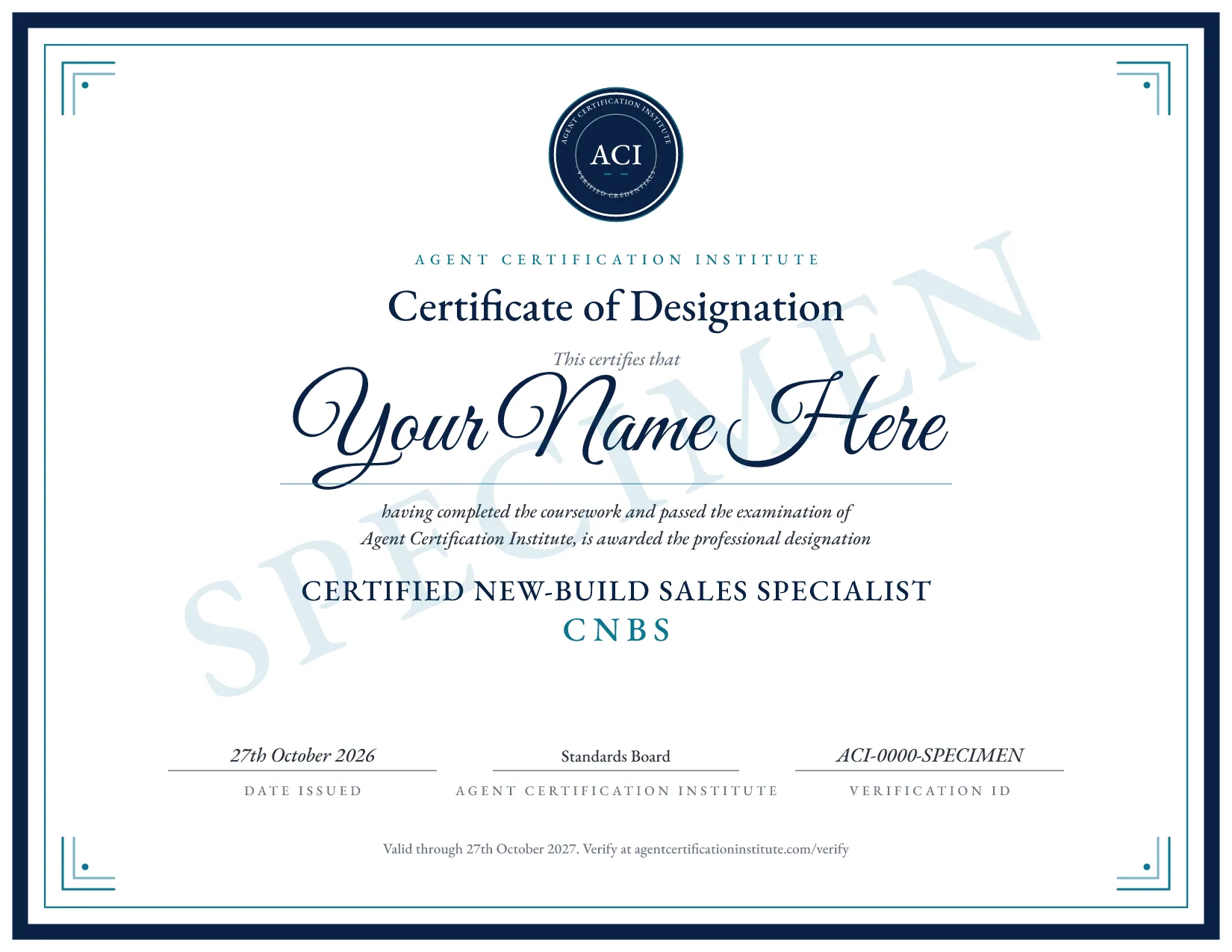
- 1A full US Letter certificate in your name, as a print-ready PDF and an image for your website and listings.
- 2Dated the day you pass and valid for 12 months, with a verification ID anyone can check on our public register.
- 3Renewed each year with a short update on what changed and a ten-question check ($29, or free with All-Access). You get a re-dated certificate and badge.
Questions
Frequently asked
Is the Certified New-Build Sales Specialist designation affiliated with NAR?+
No. The Certified New-Build Sales Specialist is an independent designation from Agent Certification Institute and is not affiliated with or endorsed by the National Association of REALTORS. It shows that you completed our training on representing buyers and builders in new construction, reviewing builder contracts at agent level, guiding design studio decisions and discussing accessory dwelling units, and that you passed the final exam.
Do I need a construction background?+
No. The program explains building stages, common materials and inspection points in plain terms suited to an agent, not a contractor. You are not expected to judge workmanship yourself; you learn what to watch for, when to bring in a licensed inspector, and how to communicate with a builder's site team. Some resale experience helps, since the course contrasts new construction with the process you already know.
How much does the ADU module cover?+
It covers what an agent needs to discuss accessory dwelling units responsibly: common types, how zoning and permit rules shape what can be built, why permit history matters when buying or listing a home with an existing unit, and how to describe a unit accurately in marketing. It does not teach design, construction costs or rental projections, and because ADU rules vary by state and city, you always check yours.
Does this help when my buyer's build is delayed?+
Yes. Delays are one of the most common sources of stress in new construction, and the program covers how to read the delay and extension terms in a builder contract, how to keep the buyer's rate lock, lease and moving plans in view with their lender and landlord, and how to communicate with the builder without damaging the relationship. You will not advise on legal remedies, but you will know when to suggest an attorney.
Is this designation a good fit for a newer agent?+
It can be, particularly in markets where many first transactions involve new subdivisions. The program explains the new-build process from the beginning, and newer agents often find builder sales offices a good place to meet buyers. Pair it with the Certified Buyer Consultation Specialist if you are still building your buyer process, since that designation covers the written buyer agreement and consultation skills this one assumes.
How does the ADU module help with buyers rather than sellers?+
Buyers increasingly ask whether they could add a unit for a relative, a home office or rental income. The module shows you how to answer at agent level: pointing them to the city's zoning and permit information, suggesting they consult a designer or contractor before relying on a plan, and making sure feasibility questions are explored during their contingency period where the contract allows. You help them ask the right questions rather than promising what can be built.
How long does it take?+
It is self-paced and fully online: 4 units, each a solid evening of reading plus a practice quiz and a short assignment you do in your own business. Most agents finish over a week or two. Written exam answers are marked within two business days.
Is it verifiable?+
Yes. Every CNBS holder gets a public verification page and a shareable digital badge for LinkedIn, your bio, and your email signature.
How long is it valid?+
Your CNBS certificate is dated the day you pass and is valid for 12 months, and your badge shows the years it is current for. A month before it lapses we email you. Renewing means reading that year's short update on what changed for CNBS holders and answering ten multiple-choice questions, for $29; you then get a re-dated certificate and badge. All-Access members renew free.
Is there a guarantee?+
Yes. Enroll with confidence. If a designation is not right for you, email us within 30 days for a full refund. No forms, no hassle. Two exam attempts are included with every designation, and if you need another we add it at no extra cost.
Can I get this and others for one price?+
Yes. The all-access membership unlocks CNBS and every other designation for $199 a year, and saves $1450 against buying the catalog one at a time.
Be first in when the CNBS opens
Every course is written to our full standard before it goes on sale. Leave your email and we will tell you the day enrollment opens. One email, no spam.
You are on the list. We will email you the day it opens.
Guides for agents
Part of a learning path
CNBS is one step in this path: a suggested set of designations, in the order an agent tends to need them.
More in Client Specialties

Certified Downsizing & Senior Move Specialist
Guide later-life moves and downsizing with patience and care.

Certified Probate & Inherited Home Specialist
Sell probate and inherited homes alongside the attorneys and families involved.

Certified Military & Veteran Homebuyer Specialist
Serve service members and veterans through moves on a military timeline.