Certified Probate & Inherited Home Specialist
An online probate and inherited home course and certification for real estate agents.
Sell probate and inherited homes alongside the attorneys and families involved.
About the CPIH
What the Certified Probate & Inherited Home Specialist covers
The Certified Probate & Inherited Home Specialist (CPIH) program prepares agents to list and sell homes that pass through an estate or to heirs. You will learn how to work with a personal representative and the estate's attorney, how court confirmation can affect a sale in the places that use it, and how to handle a property that may have sat empty, need repairs or hold a lifetime of belongings. The program also covers communicating with several heirs who may live far apart and disagree. It is designed for licensed agents who want to be organized and genuinely useful in these sales while leaving every legal question with the attorney and the court.
Why it matters
Why agents earn the CPIH
When a home passes through an estate, the personal representative usually needs an agent who understands the paperwork rhythm, the vacant property and the family pressures, and attorneys keep returning to agents who make that work easier rather than harder.
Who it is for
Is this designation right for you?
- Agents who want referrals from estate and probate attorneys
- Agents who list vacant homes needing cleanouts and repairs
- Agents who stay steady with grieving or divided families
- Agents prospecting estate listings who want to do it respectfully
The curriculum
What you will learn
4 units, each with a practice quiz and a hands-on assignment, then the final exam. The topics they cover:
Who has authority to sell
Identifying the personal representative, confirming their authority through the attorney, and knowing who signs which documents.
Working with the estate attorney
Sharing timelines, documents and offers with counsel so legal steps and marketing steps stay aligned.
Court confirmation where it applies
How court approval and overbidding can shape a sale in some jurisdictions, and how to prepare buyers for it.
Securing and assessing the property
Handling vacancy, utilities, deferred maintenance and as-is condition with care and careful written documentation.
Communicating with multiple heirs
Keeping heirs informed through the representative, with consistent updates and clear boundaries on who directs the sale.
Prospecting estates respectfully
Reaching estate contacts ethically, honoring do-not-call rules, and never pressuring a grieving family to list.
The payoff
What you will be able to do
- Confirm who holds authority to sign before any listing paperwork
- Coordinate listing and offer steps with the estate's attorney
- Prepare buyers and sellers for court confirmation where it applies
- Document and market an as-is or long-vacant inherited home
- Keep multiple heirs informed without taking sides or giving legal advice
In practice
What the CPIH looks like in your business
The first call from a personal representative
A woman calls to say her father died in the spring and she has been named to handle his estate, including the house. Before you discuss price, you ask a few organizing questions: whether an attorney is involved, whether the court has formally appointed her, whether anyone is living in the home, and whether she has told the insurer it is vacant. You do not tell her what her authority allows. Instead, you explain that the attorney will confirm what she can sign and when, and you ask permission to contact counsel directly. Then you describe what you can start now: a walk-through, a list of condition notes, and an estimate of what the house might sell for as it stands. CPIH drills this call because a clear, modest first conversation sets the tone for the whole estate sale.
Listing a house nobody has lived in
The home has been empty for eight months. The lawn is long, the refrigerator was left running, and there is a water stain on the bedroom ceiling. Your job is to document, not to diagnose. You photograph conditions, note what you observe in plain language, and recommend that the representative consider inspections or a contractor's opinion before deciding between selling as-is or making repairs. You talk through disclosure with the attorney, since what an estate must disclose varies by state. When the heirs want to list at the price a neighbor got after a full renovation, you show sales of homes in similar condition and explain the gap. An assignment asks you to write a condition summary and a pricing memo for exactly this kind of property, because honest documentation protects the estate, the buyer and you.
Overbids, court dates and anxious buyers
Your listing needs court approval, and a buyer's agent calls asking why their accepted offer is not final. In places that use court confirmation, an accepted offer may still face a hearing where other buyers can bid more. You explain this process in general terms, point the buyer to their own agent and attorney for specifics, and share the hearing date once the estate's attorney confirms it. You prepare your own side too, so the representative knows what to expect at the hearing. Where confirmation does not apply, you explain why the timeline still depends on estate paperwork. These conversations get their own unit, so you can keep buyers engaged through a slower process and avoid promising dates or outcomes that only the court controls. Rules vary by state and county, so you always confirm the local process with counsel.
Who earns it
Who earns the CPIH and why it pays off
CPIH suits agents who want a steady, referral-based practice built around estates, and who are comfortable with slower timelines and careful paperwork. The most natural partners are estate and probate attorneys, who often need an agent that returns calls, documents property condition and respects the legal process, along with professional fiduciaries, accountants and estate sale companies. Once one attorney trusts your files, introductions to colleagues tend to follow, and a public verification page gives them something simple to share with a client. The designation also changes how you speak to families. You stop being the agent who asks for a listing and become the one who explains, in order, what will happen to the house and who decides each step. Many inherited homes belonged to older owners, so CPIH pairs well with the Certified Downsizing & Senior Move Specialist, which covers moves made while the owner is still living. Agents who sell many as-is estate homes also benefit from the Certified Market Analysis Specialist for pricing property in unusual condition.
Licensing, CE credit and NAR
Think of CPIH as a focused, independent ACI designation rather than a license. It does not license you to do anything that requires a license, it does not provide state continuing-education (CE) credit, and it is neither affiliated with nor endorsed by the National Association of REALTORS (NAR). No NAR designation covers this exact niche of probate and inherited home sales, so there is no direct counterpart. CPIH is built around the estate sale itself. You complete self-paced online units with hands-on tasks, pass an exam that includes written answers read by a person, and receive a certificate anyone can check on a public verification page. It is renewed every year with a short update on what changed. It is not legal training and does not qualify you to act as a fiduciary.
What is included
Every ACI designation includes
- Scenario-based lessons built around real transactions and client conversations
- Copy-and-use scripts, checklists, and templates you can apply this week
- A final exam with written answers read by a real marker, not just a click-through quiz
- A printable certificate plus a verifiable digital badge
- Post-nominal letters you can add to your name and marketing
The process
How it works
Enroll online
Get instant access to the CPIH coursework. No scheduling, no classroom.
Learn at your pace
4 practical, scenario-based units with practice quizzes and hands-on assignments.
Pass the exam
Multiple choice plus short written answers, read by a person. 2 attempts included.
Earn your designation
Receive your CPIH certificate, a shareable badge, and a public verification page.
30-day money-back guarantee
Enroll with confidence. If a designation is not right for you, email us within 30 days for a full refund. No forms, no hassle.
Two exam attempts are included with every designation, and if you need another we add it at no extra cost.
Your CPIH certificate
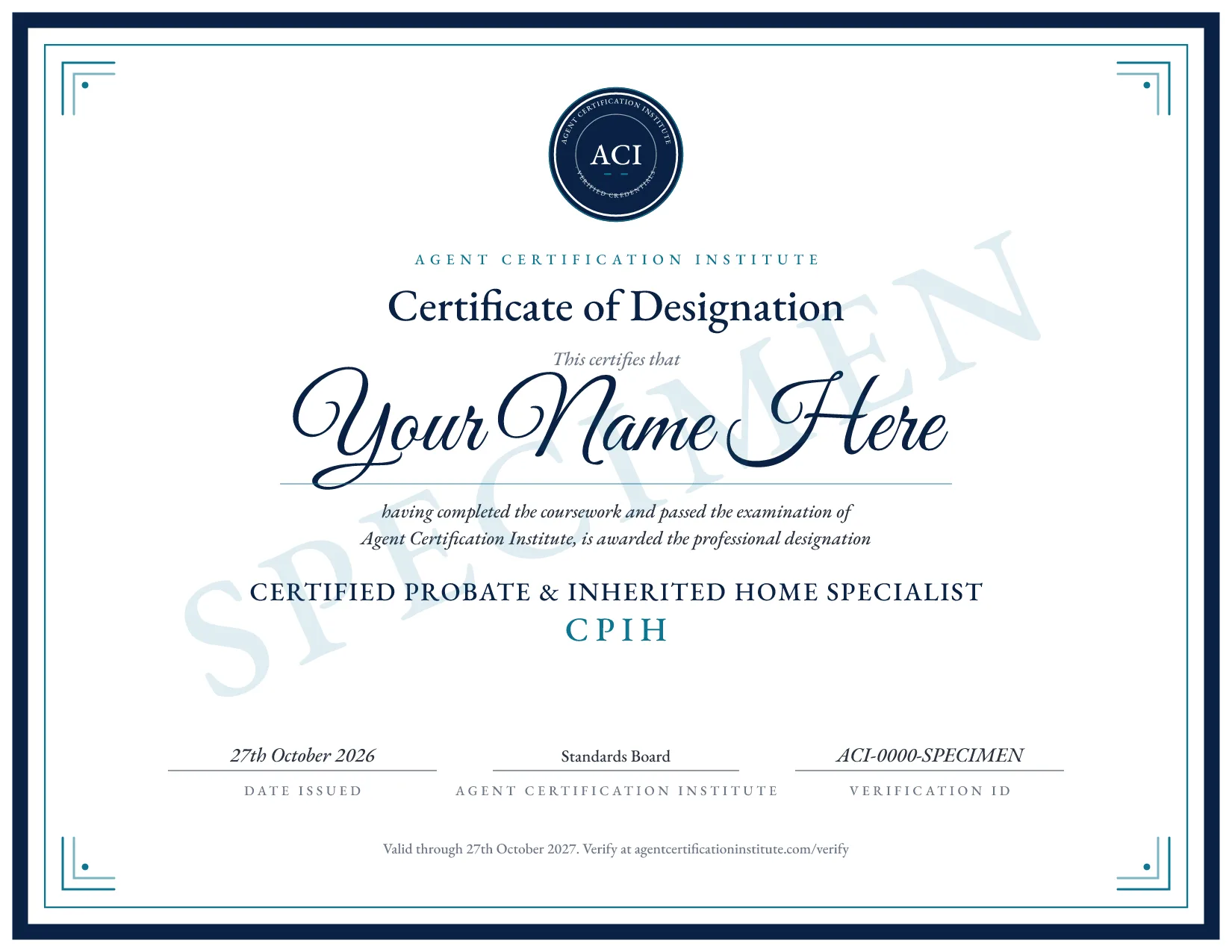
- 1A full US Letter certificate in your name, as a print-ready PDF and an image for your website and listings.
- 2Dated the day you pass and valid for 12 months, with a verification ID anyone can check on our public register.
- 3Renewed each year with a short update on what changed and a ten-question check ($29, or free with All-Access). You get a re-dated certificate and badge.
Questions
Frequently asked
Is the Certified Probate & Inherited Home Specialist designation affiliated with NAR?+
No. Agent Certification Institute issues this designation independently, and it is not affiliated with or endorsed by the National Association of REALTORS. Holding it means you completed ACI's probate and inherited home training and passed the exam. It is a voluntary professional credential that sits alongside your license, not part of any association membership.
Do I need probate experience to enroll?+
No. You need a real estate license and a working knowledge of a standard listing. The program explains the estate side from the agent's seat and assumes no legal training. Agents who have never handled an estate sale often find the authority and court-confirmation units the most useful, because those are the points where an ordinary listing process would go wrong.
Does CPIH cover trusts and other ways property passes to heirs?+
At an agent's level, yes. Not every inherited home goes through probate, and some pass through a trust or another arrangement. The program explains why the paperwork and the person signing may differ in those cases, and why you confirm the details with the attorney. It does not teach estate law, and it never replaces legal advice.
How do I prospect probate leads without crossing a line?+
The program treats prospecting as a matter of respect first. You learn to use public records only as your state and local rules permit, to honor do-not-call and opt-out requests, to allow a decent interval before contacting a family, and to lead with useful information rather than a listing pitch. You also learn never to imply a connection to the court or the attorney. Check your state's rules and your broker's policy before starting any campaign.
How does CPIH help when heirs disagree about the sale?+
You learn to route decisions through the personal representative, who usually directs the sale, and to give every heir the same factual update when the representative approves it. When an heir objects to price or timing, you share the market evidence and leave the dispute itself to the representative and the attorney. You never negotiate between heirs or suggest who should receive what, since dividing an estate is a legal matter.
Is this designation a good fit for a team or a newer agent?+
Both can benefit. On a team, one member often becomes the estate contact for attorneys, and CPIH gives that person a defined process the rest of the team can follow. Newer agents can take it too, though a probate listing is rarely the easiest first listing, so working closely with an experienced broker on your first estate sale is wise. The units move at your own pace and fit around active business.
How long does it take?+
It is self-paced and fully online: 4 units, each a solid evening of reading plus a practice quiz and a short assignment you do in your own business. Most agents finish over a week or two. Written exam answers are marked within two business days.
Is it verifiable?+
Yes. Every CPIH holder gets a public verification page and a shareable digital badge for LinkedIn, your bio, and your email signature.
How long is it valid?+
Your CPIH certificate is dated the day you pass and is valid for 12 months, and your badge shows the years it is current for. A month before it lapses we email you. Renewing means reading that year's short update on what changed for CPIH holders and answering ten multiple-choice questions, for $29; you then get a re-dated certificate and badge. All-Access members renew free.
Is there a guarantee?+
Yes. Enroll with confidence. If a designation is not right for you, email us within 30 days for a full refund. No forms, no hassle. Two exam attempts are included with every designation, and if you need another we add it at no extra cost.
Can I get this and others for one price?+
Yes. The all-access membership unlocks CPIH and every other designation for $199 a year, and saves $1450 against buying the catalog one at a time.
Be first in when the CPIH opens
Every course is written to our full standard before it goes on sale. Leave your email and we will tell you the day enrollment opens. One email, no spam.
You are on the list. We will email you the day it opens.
Guides for agents
Part of a learning path
CPIH is one step in this path: a suggested set of designations, in the order an agent tends to need them.
More in Client Specialties

Certified Downsizing & Senior Move Specialist
Guide later-life moves and downsizing with patience and care.

Certified Military & Veteran Homebuyer Specialist
Serve service members and veterans through moves on a military timeline.

Certified Divorce Property Specialist
Sell the home during a divorce as the calm, neutral professional.