Certified Downsizing & Senior Move Specialist
An online downsizing and senior move course and certification for real estate agents.
Guide later-life moves and downsizing with patience and care.

About the CDSM
What the Certified Downsizing & Senior Move Specialist covers
The Certified Downsizing & Senior Move Specialist (CDSM) program teaches agents to manage a later-life move from the first kitchen-table conversation to the day the keys change hands. You will learn how to set a pace the client can live with, how to involve adult children and other relatives without letting them take over, and how to compare next-home options such as a smaller house, a condo, a rental or a community with services. The program also covers working alongside senior move managers, estate sale companies and other specialists. It is written for licensed agents who want a calm, organized process for these moves, while financial, elder-care and reverse-mortgage questions go to the right professionals.
Why it matters
Why agents earn the CDSM
Many homeowners who bought decades ago are now weighing a smaller home or a move closer to family, and they choose agents who can slow down, coordinate several helpers and keep the client's own wishes at the center of every decision.
Who it is for
Is this designation right for you?
- Agents whose sphere includes longtime homeowners thinking about moving smaller
- Agents who field calls from adult children planning a parent's move
- Agents who want referral relationships with senior move managers
- Agents who prefer patient, well-paced work over rushed listings
The curriculum
What you will learn
4 units, each with a practice quiz and a hands-on assignment, then the final exam. The topics they cover:
Pacing a later-life move
Building a timeline around the client's readiness, health and next home rather than the market calendar alone.
The family conversation
Including adult children and relatives while confirming that the homeowner remains the decision-maker and your client.
Comparing next-home options
Describing smaller homes, condos, rentals and service-based communities factually so clients can weigh them with their advisors.
Working with move managers
Coordinating senior move managers, estate sale firms, donation services and cleanouts around the listing schedule.
Selling the long-held home
Preparing a well-loved, often dated house for market with practical repairs and realistic expectations.
Knowing where your role ends
Referring financial, elder-care, legal and reverse-mortgage questions to qualified professionals without leaving the client stranded.
The payoff
What you will be able to do
- Build a move timeline that matches the client's readiness and next home
- Run family meetings that keep the homeowner in charge of decisions
- Explain next-home options factually, without steering or pressure
- Coordinate a listing schedule with move managers and estate sale firms
- Refer financial, elder-care and reverse-mortgage questions to the right professional
In practice
What the CDSM looks like in your business
The first visit to a fifty-year home
You arrive for what the daughter called a listing appointment, and within ten minutes it is clear her mother has not decided to move at all. Rather than pulling out comps, you change the meeting's purpose. You ask the homeowner what a good next year would look like, where she wants to be, and what worries her about leaving. You note the rooms she mentions most and the belongings she names first. Then you lay out what a move would involve, step by step, with no dates attached, and you suggest a second visit once she has thought it over. CDSM frames this as a deliberate choice: an unhurried first meeting protects the client's autonomy, earns the trust of the whole family, and usually leads to a listing that is ready when the seller is, not when the calendar says.
Coordinating the move manager and the listing
The house is full, the closing on the new condo is six weeks out, and three different helpers have three different ideas about what happens first. You pull the schedule into one shared document. The senior move manager plans the layout of the new home and decides what goes with the client. The estate sale company needs a set weekend and a house the family has already cleared of keepsakes. The cleanout crew follows, then the handyman, then the photographer. You work backward from the listing date and tell each party exactly when their window opens and closes. When the client's son asks to delay the estate sale, you show him what that shifts downstream. One written assignment has you build this sequence, since a later-life move usually falters on logistics rather than price, and a clear timeline lowers stress for everyone.
When the question is not about real estate
Halfway through a pricing conversation, your client asks whether she should take out a reverse mortgage instead of selling, or whether the proceeds will affect her eligibility for care benefits. These are fair questions, and they are not yours to answer. You tell her so directly and kindly, explain that the answer depends on her finances and health in ways only a qualified lender, financial planner or elder law attorney can assess, and offer to pause the listing timeline while she gets that advice. You can still share what you do know: recent sales nearby, what preparing the home would involve, and how long similar homes have taken to sell. Holding this line consistently is a core skill here, because an agent who guesses at financial or care questions puts the client at risk, and their own license with it.
Who earns it
Who earns the CDSM and why it pays off
This designation fits agents who already find themselves helping longtime homeowners, often through a sphere that has aged alongside them, and who want a structured way to do that work well. It also suits agents who hear from adult children living in another city and trying to help a parent from a distance. The clearest referral sources are senior move managers, estate sale companies, elder law attorneys and financial planners, all of whom need an agent they can trust to move at the client's pace and to stay out of their territory. Holding a named designation, with a public page that confirms it, gives those professionals a simple reason to send a family your way. It also changes the first conversation with clients: instead of asking for a listing, you are describing a process. Agents who meet many estate situations often pair CDSM with the Certified Probate & Inherited Home Specialist, and both sit in the Life Events Path alongside the Certified Divorce Property Specialist.
Licensing, CE credit and NAR
CDSM is an independent ACI designation. It is not a real estate license, it does not license you to do anything that requires one, and it is not state continuing-education (CE) credit. ACI has no affiliation with the National Association of REALTORS (NAR), which does not endorse it. The closest NAR credential is the Seniors Real Estate Specialist (SRES) designation, a well-regarded program that covers serving older clients across a broad range of topics. CDSM is narrower: it concentrates on the mechanics of a downsizing move, the family and the move-manager team. You earn it through self-paced units, an exam with written answers read by a person, and a certificate anyone can verify, and it renews each year with a short update. It is not a senior move manager credential or any kind of financial or care qualification.
What is included
Every ACI designation includes
- Scenario-based lessons built around real transactions and client conversations
- Copy-and-use scripts, checklists, and templates you can apply this week
- A final exam with written answers read by a real marker, not just a click-through quiz
- A printable certificate plus a verifiable digital badge
- Post-nominal letters you can add to your name and marketing
The process
How it works
Enroll online
Get instant access to the CDSM coursework. No scheduling, no classroom.
Learn at your pace
4 practical, scenario-based units with practice quizzes and hands-on assignments.
Pass the exam
Multiple choice plus short written answers, read by a person. 2 attempts included.
Earn your designation
Receive your CDSM certificate, a shareable badge, and a public verification page.
30-day money-back guarantee
Enroll with confidence. If a designation is not right for you, email us within 30 days for a full refund. No forms, no hassle.
Two exam attempts are included with every designation, and if you need another we add it at no extra cost.
Your CDSM certificate
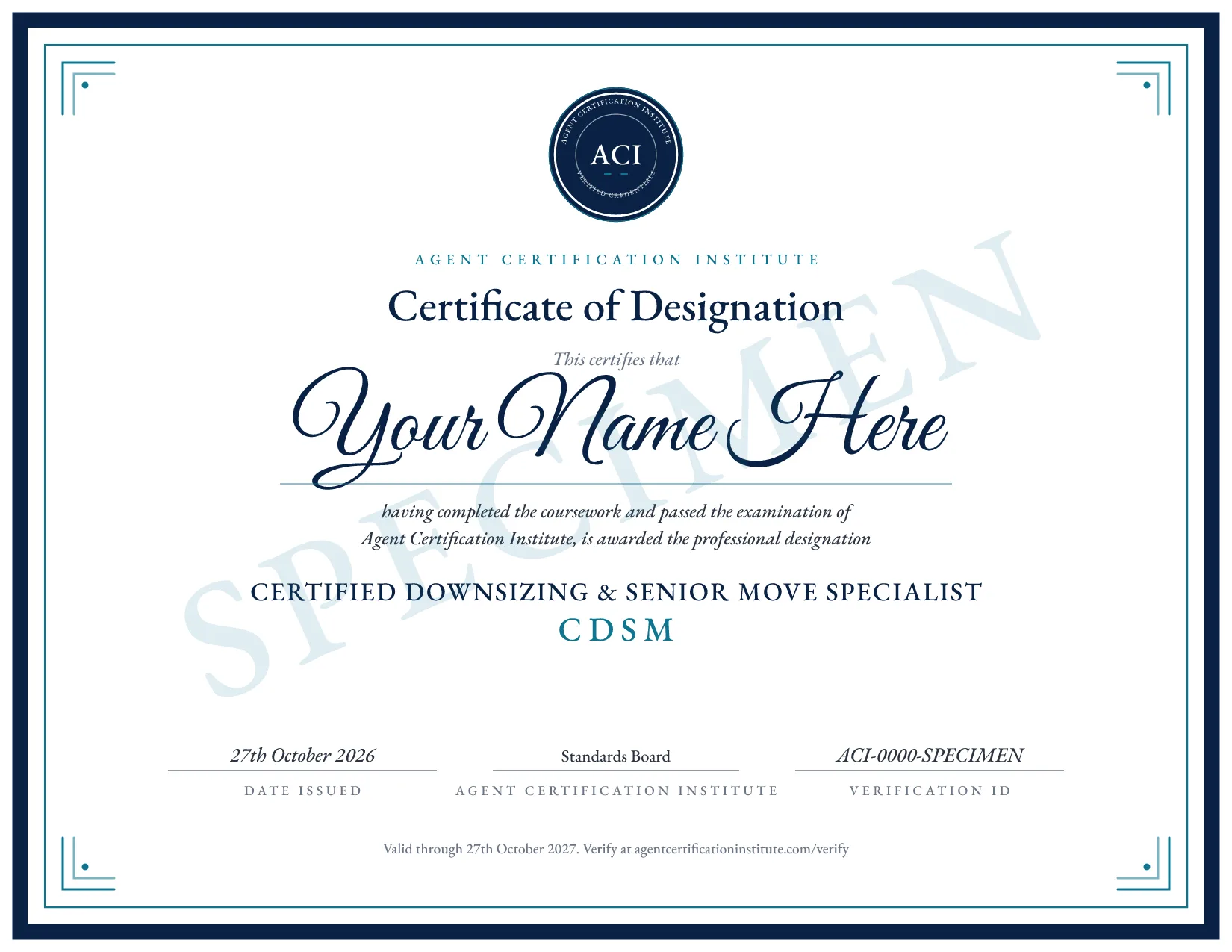
- 1A full US Letter certificate in your name, as a print-ready PDF and an image for your website and listings.
- 2Dated the day you pass and valid for 12 months, with a verification ID anyone can check on our public register.
- 3Renewed each year with a short update on what changed and a ten-question check ($29, or free with All-Access). You get a re-dated certificate and badge.
Questions
Frequently asked
Is the Certified Downsizing & Senior Move Specialist designation affiliated with NAR?+
No. The Certified Downsizing & Senior Move Specialist is an independent designation from Agent Certification Institute. It is not affiliated with or endorsed by the National Association of REALTORS, and it does not stand in for any NAR credential. It shows that you completed ACI's training and passed its exam on later-life moves and downsizing.
Do I need experience with older clients before starting?+
No. You need a real estate license and a working grasp of how a listing runs. The units assume no background in senior housing or move management. Agents who already serve longtime homeowners tend to recognize the situations quickly and can apply the assignments to clients they are working with right now.
Will this course teach me to advise on reverse mortgages or care options?+
No. Reverse mortgages, retirement income, benefits planning and care decisions sit outside an agent's role. The program teaches you to notice when a client's question has crossed into those areas, to say so plainly, and to suggest they speak with a lender, financial planner, elder law attorney or care professional before deciding anything about the sale.
Is this a credential for senior move managers?+
No. CDSM is a real estate designation for licensed agents. Senior move managers handle sorting, packing, floor plans and the physical move, and that is a separate profession with its own training. The program teaches you how their work fits around a listing so you can coordinate with them smoothly, but it does not qualify you to run a move management business or to replace one.
How does it help when the family disagrees about selling?+
The family unit teaches you to identify who your client is, usually the homeowner, and to keep that person at the center when relatives pull in different directions. You practice running a short family meeting with an agenda, recording decisions in writing, and sending one summary to everyone the client has authorized. If a disagreement is really about money, inheritance or capacity, you step back and point the family to an attorney.
Can a newer agent take this, or should I start elsewhere?+
A newer agent can take it, and the material is approachable. If you have not yet handled a listing from start to finish, though, consider starting with the Certified Home Listing Specialist so the listing basics feel familiar. CDSM then adds the pacing, family and coordination layer on top. Like every ACI designation it is self-paced; most agents finish over a few weeks of evenings.
How long does it take?+
It is self-paced and fully online: 4 units, each a solid evening of reading plus a practice quiz and a short assignment you do in your own business. Most agents finish over a week or two. Written exam answers are marked within two business days.
Is it verifiable?+
Yes. Every CDSM holder gets a public verification page and a shareable digital badge for LinkedIn, your bio, and your email signature.
How long is it valid?+
Your CDSM certificate is dated the day you pass and is valid for 12 months, and your badge shows the years it is current for. A month before it lapses we email you. Renewing means reading that year's short update on what changed for CDSM holders and answering ten multiple-choice questions, for $29; you then get a re-dated certificate and badge. All-Access members renew free.
Is there a guarantee?+
Yes. Enroll with confidence. If a designation is not right for you, email us within 30 days for a full refund. No forms, no hassle. Two exam attempts are included with every designation, and if you need another we add it at no extra cost.
Can I get this and others for one price?+
Yes. The all-access membership unlocks CDSM and every other designation for $199 a year, and saves $1450 against buying the catalog one at a time.
Be first in when the CDSM opens
Every course is written to our full standard before it goes on sale. Leave your email and we will tell you the day enrollment opens. One email, no spam.
You are on the list. We will email you the day it opens.
Guides for agents
Part of a learning path
CDSM is one step in this path: a suggested set of designations, in the order an agent tends to need them.
More in Client Specialties

Certified Probate & Inherited Home Specialist
Sell probate and inherited homes alongside the attorneys and families involved.

Certified Military & Veteran Homebuyer Specialist
Serve service members and veterans through moves on a military timeline.

Certified Divorce Property Specialist
Sell the home during a divorce as the calm, neutral professional.