Certified Investor Client Specialist
An online course and certification for real estate agents who work with investor clients.
Speak the numbers investors care about and find deals that pencil.

About the CICS
What the Certified Investor Client Specialist covers
The Certified Investor Client Specialist (CICS) program prepares agents to represent buyers and sellers who treat property as a business. You will learn to build a simple rental analysis from rents, expenses and the financing terms a client supplies, to support fix-and-flip clients with comps, repair scopes and resale timing, and to research short-term rental rules before a client commits. Just as important, the program draws a firm line around your role: securities, tax, 1031 exchange and lending questions go to licensed professionals. It is designed for licensed agents who want investor clients to see them as a prepared, numbers-literate partner who knows exactly where real estate advice stops.
Why it matters
Why agents earn the CICS
Investor clients buy repeatedly, judge agents on speed and accuracy, and quickly drop anyone who guesses at numbers or rules, so an agent with a disciplined analysis process and clear professional limits can earn ongoing business that does not depend on one move.
Who it is for
Is this designation right for you?
- Agents who receive inquiries from rental and small multifamily buyers
- Agents working with fix-and-flip clients on purchase and resale
- Agents in markets where short-term rental rules keep changing
- Agents who want clear boundaries around tax and securities questions
The curriculum
What you will learn
4 units, each with a practice quiz and a hands-on assignment, then the final exam. The topics they cover:
Understanding investor goals
Clarifying strategy, hold period, financing and risk limits before searching, so every property is screened against them.
Rental analysis basics
Estimating income and expenses from verifiable sources and showing clients how each assumption changes the outcome.
Fix-and-flip clients
Supporting purchase decisions with renovated comps, contractor estimates, realistic resale timing and monthly holding costs.
Short-term rental local rules
Researching permits, zoning, HOA restrictions and local ordinances before a client buys for nightly rental.
Selling for investors
Listing tenant-occupied or recently renovated property while respecting tenant rights and disclosure duties.
Where agent advice stops
Referring securities, tax, 1031 exchange, entity and lending questions to the licensed professionals who handle them.
The payoff
What you will be able to do
- Build a rental analysis that labels every assumption and its source
- Support fix-and-flip decisions with comps and documented repair scopes
- Research short-term rental rules before a client writes an offer
- List tenant-occupied property with attention to tenant rights and notice
- Refer securities, tax and 1031 questions to licensed professionals promptly
In practice
What the CICS looks like in your business
The rental analysis a client can trust
An investor client sends you a duplex listing and asks whether it cash flows. Rather than a quick yes or no, you build a one-page analysis. You pull current rents for similar units, ask the client for the financing terms their lender has quoted, and list every expense line: taxes, insurance, maintenance, vacancy, management and any utilities the owner pays. Next to each figure you note its source and whether it is verified or assumed. Then you show how the result changes if rent comes in lower or expenses run higher. You send it with a clear note that it is a market analysis, not investment advice, and that the client should review it with their own accountant. Investors remember the agent whose numbers held up, and labeled assumptions protect you when they do not.
Walking a flip before the offer
Your flipper client wants to offer on a dated ranch house today. You walk it with the client and, ideally, their contractor, noting the scope they describe: roof, kitchen, baths, flooring, possibly the electrical panel. Back at your desk you pull resale comps for renovated homes of similar size nearby and older sales of unrenovated ones, so the client can see both ends of the plan. You ask how long they expect the work to take and remind them that holding costs build every month. You do not estimate construction costs yourself or promise a resale price. You present the comparable sales, a realistic marketing time for the finished home, and the questions their contractor and lender should answer. CICS uses this scenario as an assignment, because a careful pre-offer review is what brings flip clients back for the next purchase and the resale listing.
A buyer planning to rent nightly
A client from out of state wants a condo near the beach to run as a short-term rental. Before you send listings, you research what is actually permitted. You check the city or county ordinance, any permit cap or waiting list, the zoning, and, for every condo you consider, the HOA documents, which may prohibit rentals below a minimum length. You record where each answer came from and the date you checked, because these rules change. When something is unclear, you tell the client to confirm with the local permitting office or an attorney before relying on it. You also avoid presenting projected nightly income as fact. The point of this sequence is simple: a client who buys a home they cannot legally rent will blame the agent who never raised the question, while an agent who flags the rules early becomes a trusted resource.
Who earns it
Who earns the CICS and why it pays off
CICS is designed for agents who serve buyers and sellers making business decisions about property: small landlords adding a unit, flippers who buy several homes a year, and out-of-area buyers looking at rentals. These clients refer one another, and they also bring you into contact with lenders who specialize in investment loans, property managers, contractors, accountants and the qualified intermediaries who handle exchanges. Each of those professionals prefers an agent who sends clean information and does not stray into their work. A designation with a public verification page signals that you have studied both the analysis and its limits. The conversation with an investor changes too. Instead of asking what they want to buy, you begin with strategy, hold period and risk, and your analysis follows the same structure every time. CICS pairs well with the Certified Market Analysis Specialist for sharper comps and pricing, and with the Certified Transaction Coordination Specialist for agents juggling several investor files at once.
Licensing, CE credit and NAR
CICS is an independent ACI designation and should be described that way. It is not a real estate license, it does not license you to do anything that requires one, and it is not state continuing-education (CE) credit. It is also not a securities, investment adviser, tax or lending credential. ACI is not affiliated with or endorsed by the National Association of REALTORS (NAR). Agents with commercial ambitions often know the CCIM designation, a respected credential focused on commercial investment real estate with considerable depth in financial analysis. CICS covers different ground: residential investor clients such as rentals, flips and short-term rentals, at an agent's level. You earn it through self-paced online units, an exam that includes written answers read by a person, and a certificate anyone can check on a public verification page, renewed each year.
What is included
Every ACI designation includes
- Scenario-based lessons built around real transactions and client conversations
- Copy-and-use scripts, checklists, and templates you can apply this week
- A final exam with written answers read by a real marker, not just a click-through quiz
- A printable certificate plus a verifiable digital badge
- Post-nominal letters you can add to your name and marketing
The process
How it works
Enroll online
Get instant access to the CICS coursework. No scheduling, no classroom.
Learn at your pace
4 practical, scenario-based units with practice quizzes and hands-on assignments.
Pass the exam
Multiple choice plus short written answers, read by a person. 2 attempts included.
Earn your designation
Receive your CICS certificate, a shareable badge, and a public verification page.
30-day money-back guarantee
Enroll with confidence. If a designation is not right for you, email us within 30 days for a full refund. No forms, no hassle.
Two exam attempts are included with every designation, and if you need another we add it at no extra cost.
Your CICS certificate
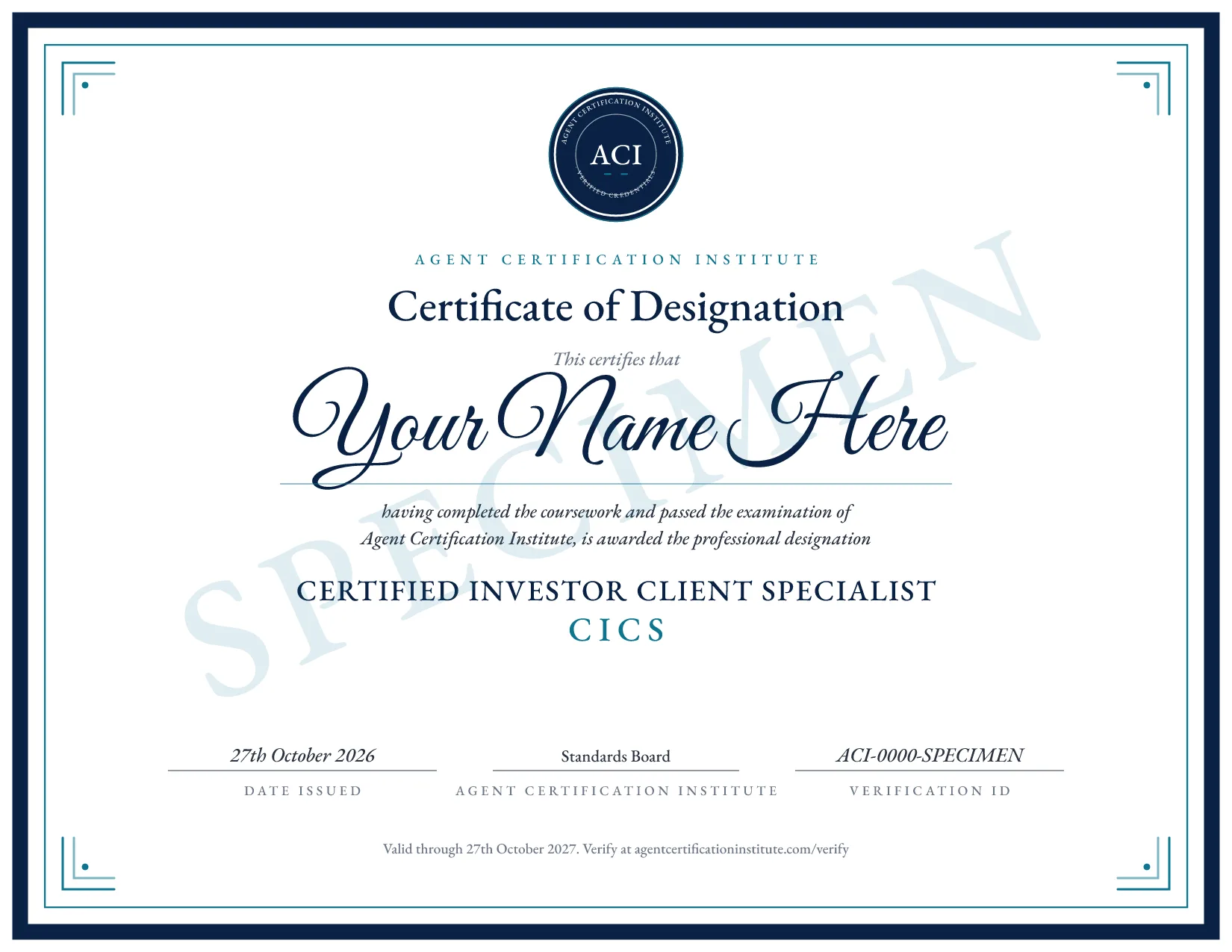
- 1A full US Letter certificate in your name, as a print-ready PDF and an image for your website and listings.
- 2Dated the day you pass and valid for 12 months, with a verification ID anyone can check on our public register.
- 3Renewed each year with a short update on what changed and a ten-question check ($29, or free with All-Access). You get a re-dated certificate and badge.
Questions
Frequently asked
Is the Certified Investor Client Specialist designation affiliated with NAR?+
No. The Certified Investor Client Specialist comes from Agent Certification Institute, an independent organization, and the National Association of REALTORS has no role in it and does not endorse it. The designation records that you completed ACI's investor client training and passed the exam, and it is separate from any association membership you hold.
What should I know before starting CICS?+
You need a real estate license and comfort with basic arithmetic and spreadsheets. The units explain each calculation as they go, so no finance background is expected. Agents who have not yet handled an ordinary purchase from offer to closing may want to build that foundation first, since investor transactions add analysis on top of the usual contract work.
Can I help a client structure a group purchase or an exchange?+
Not as an adviser. Pooling money from several investors can raise securities law issues, and a 1031 exchange has tax and timing rules handled by qualified intermediaries, tax professionals and attorneys. CICS teaches you to recognize these situations early, avoid offering opinions on them, and connect the client with the right professionals while you handle the property side of the transaction.
Does CICS cover commercial property?+
Only lightly. The focus is residential investment: single-family rentals, small multifamily buildings, flips and short-term rentals. Larger commercial assets involve different valuation methods, leases and buyers, and agents interested in that path usually pursue commercial-specific training. If an investor client asks about a commercial building, the program encourages you to bring in a commercial specialist rather than stretch beyond your experience.
How should I respond if an investor asks me to bring other investors into a deal?+
Carefully, and with professional help. Raising money from other people for a property can involve securities law, and agents who solicit or pool investor funds can face serious legal exposure. CICS teaches you to recognize the request, decline to arrange or promote the investment yourself, and suggest the client speak with a securities attorney. You can still represent the client in buying the property once the structure is settled by their advisers.
Is CICS useful for a team that handles many investor clients?+
Yes. Teams often assign one member to investor clients, and CICS gives that person a repeatable format for analysis, rule research and referrals that colleagues can follow. Each person earns the designation individually and receives their own verifiable certificate. Because the units are self-paced, team members can complete them at different speeds and still apply the same methods across the team's investor files.
How long does it take?+
It is self-paced and fully online: 4 units, each a solid evening of reading plus a practice quiz and a short assignment you do in your own business. Most agents finish over a week or two. Written exam answers are marked within two business days.
Is it verifiable?+
Yes. Every CICS holder gets a public verification page and a shareable digital badge for LinkedIn, your bio, and your email signature.
How long is it valid?+
Your CICS certificate is dated the day you pass and is valid for 12 months, and your badge shows the years it is current for. A month before it lapses we email you. Renewing means reading that year's short update on what changed for CICS holders and answering ten multiple-choice questions, for $29; you then get a re-dated certificate and badge. All-Access members renew free.
Is there a guarantee?+
Yes. Enroll with confidence. If a designation is not right for you, email us within 30 days for a full refund. No forms, no hassle. Two exam attempts are included with every designation, and if you need another we add it at no extra cost.
Can I get this and others for one price?+
Yes. The all-access membership unlocks CICS and every other designation for $199 a year, and saves $1450 against buying the catalog one at a time.
Be first in when the CICS opens
Every course is written to our full standard before it goes on sale. Leave your email and we will tell you the day enrollment opens. One email, no spam.
You are on the list. We will email you the day it opens.
Guides for agents
More in Client Specialties

Certified Downsizing & Senior Move Specialist
Guide later-life moves and downsizing with patience and care.

Certified Probate & Inherited Home Specialist
Sell probate and inherited homes alongside the attorneys and families involved.

Certified Military & Veteran Homebuyer Specialist
Serve service members and veterans through moves on a military timeline.